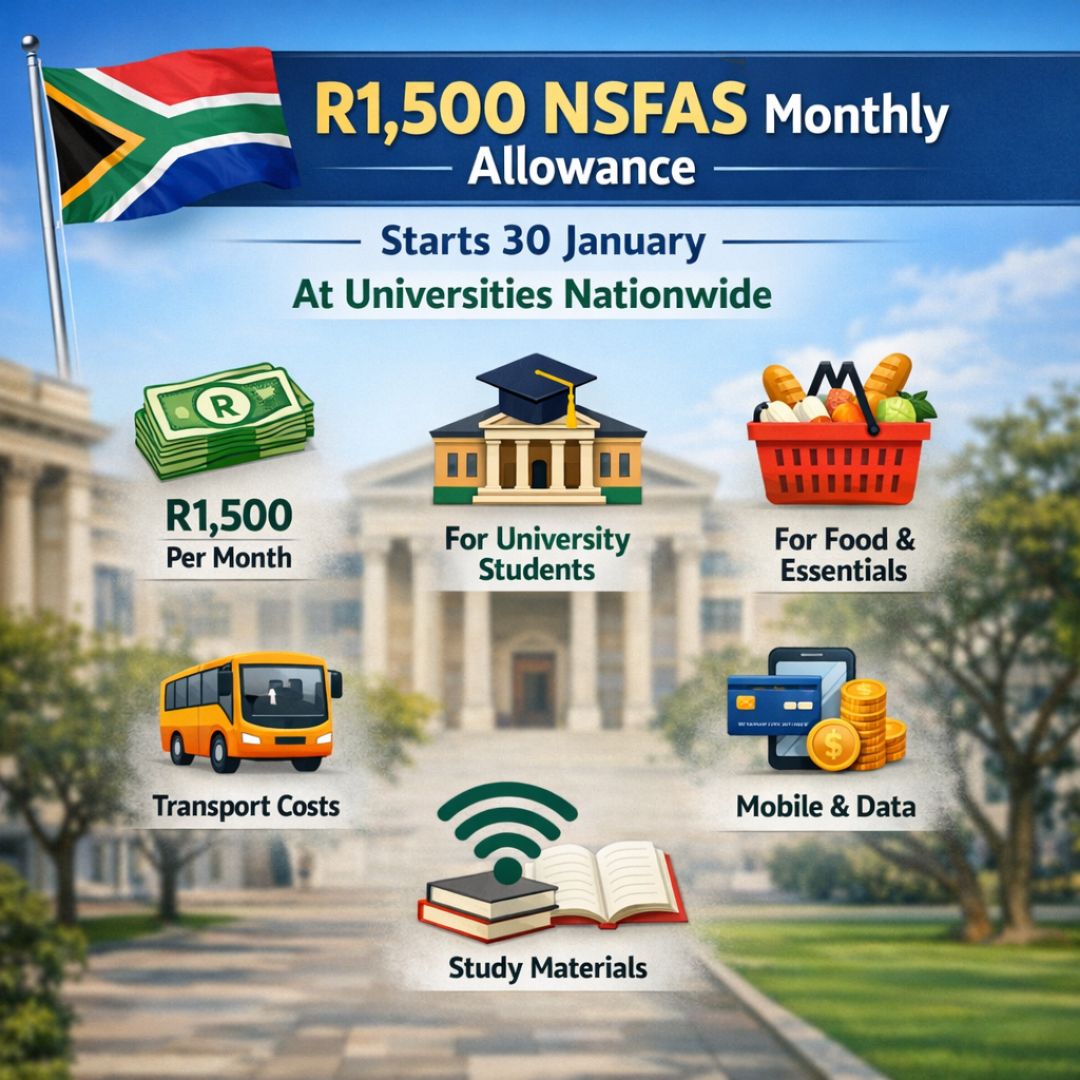
NSFAS Payouts Begin Students at South African universities will soon receive financial support from the National Student Financial Aid Scheme (NSFAS). Beginning on January 30 eligible students will get a monthly payment of R1500. This program helps students cover their daily living costs and takes some financial pressure off their families so they can concentrate on their schoolwork. Throughout the academic year this regular financial assistance makes a real difference for many students by giving them the resources they need to do well in their studies.

How the NSFAS Grant Distribution Works
The National Student Financial Aid Scheme plays a vital role in helping South African students afford higher education. Its monthly grant of R1,500 is intended to support essential living needs such as accommodation costs, daily meals, and study resources. The payout system is structured to be efficient and reliable, allowing students to receive funds on time and manage their monthly expenses with greater confidence.
– Eligibility requirements: Students must be registered at a public university or TVET college.

– Online application: Applications are submitted through the official NSFAS website.
– Enrollment verification: NSFAS coordinates with institutions to confirm registration and financial need.
– Direct payouts: Funds are paid into each student’s NSFAS Wallet account.
– Regular communication: Updated contact details ensure timely notifications.

Smart Ways to Manage Your NSFAS Monthly Allowance
Using the R1,500 monthly NSFAS grant wisely can make a meaningful difference in a student’s academic journey. Careful budget planning helps ensure that essential expenses are covered throughout the month. Prioritising spending allows students to stretch their funds further while maintaining financial stability.
Following a clear budget structure helps students meet basic living needs and still set aside money for unexpected expenses. This disciplined approach reduces financial pressure and encourages responsible money habits that can benefit students well beyond their studies.
| Expense Type | Budget Share (%) | Estimated Monthly Cost (R) |
|---|---|---|
| Housing & Accommodation | 40% | 600 |
| Food & Daily Meals | 30% | 450 |
| Books & Study Resources | 20% | 300 |
| Travel & Transportation | 10% | 150 |
The Role of NSFAS in Transforming Higher Education
The NSFAS programme has significantly shaped South Africa’s education system by making higher learning accessible to thousands of students. Through consistent financial assistance, it removes economic barriers that often prevent capable students from pursuing further studies. The impact extends beyond individuals, supporting long-term national development.
– Expanded access: Students from varied backgrounds can enter higher education.
– Improved retention: Financial support helps lower student dropout rates.
– Workforce readiness: Graduates gain skills needed in the job market.
– Economic contribution: Education strengthens national productivity.

– Social inclusion: Learning opportunities narrow socio-economic gaps.
Addressing NSFAS Implementation Challenges
Despite its importance, the NSFAS system faces certain challenges that affect students. Issues such as payment delays and administrative bottlenecks can disrupt financial planning. Continuous improvements are being introduced to minimise these obstacles and improve overall efficiency.
– Process optimisation: Simplifying procedures to speed up payments.
– Clear communication: Strengthening information flow between NSFAS and students.
– Student feedback: Using input to improve service delivery.
– Digital systems: Leveraging technology for smoother applications and verification.
Maintaining the Long-Term Sustainability of NSFAS
For NSFAS to remain effective, long-term sustainability is essential. This depends on stable funding, efficient administration, and ongoing programme improvement. Ensuring these elements allows the scheme to continue supporting future generations of students.
– Government funding: Continued public financial backing is critical.
– Strategic partnerships: Private sector collaboration helps expand resources.
– Regular oversight: Audits promote transparency and accountability.
– Innovative solutions: Adapting to changing educational needs strengthens the programme.